What is pipe relining?
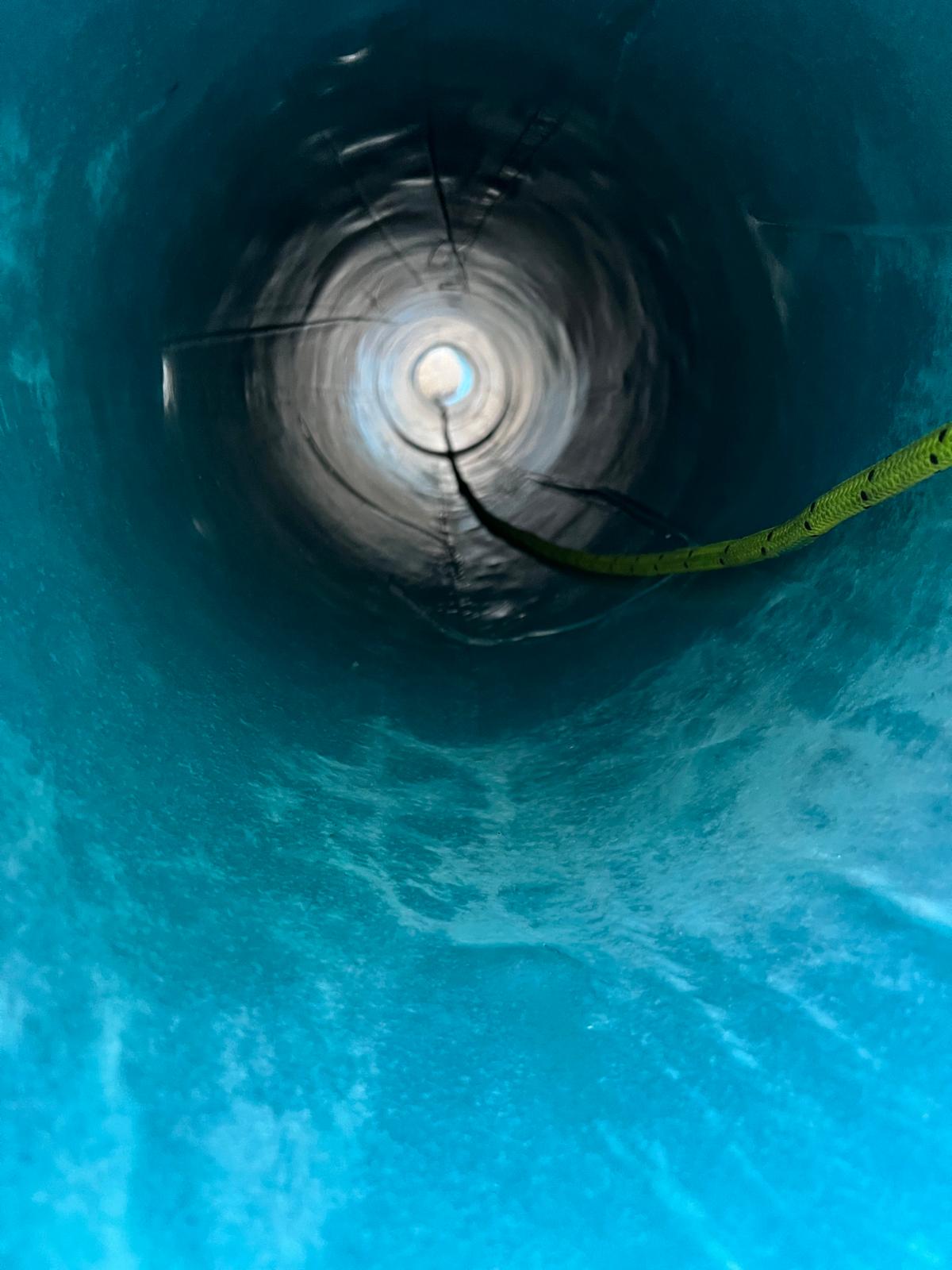
Pipe relining is a trenchless method of repairing existing pipelines from the inside, without excavating or removing the original pipe. Instead of digging up a failed drain and replacing it, a structural liner is installed within the existing host pipe and cured in place, forming a seamless, joint-free pipe within a pipe.
The process begins with a thorough CCTV inspection to identify the exact nature and location of the damage. The pipe is then cleaned and prepared using high-pressure water jetting or robotic cutting tools to remove debris, root intrusion, and any surface contamination. Once the pipe is clear, a resin-saturated liner is introduced, positioned, and cured, leaving behind a structurally sound new pipe inside the original.
The result is an asset restored to full structural integrity, with improved flow capacity and a design life of up to 50 years, without a single shovel in the ground.
Pipe relining is the method of choice when excavation is not viable: operational sites, live infrastructure, restricted access areas, and assets running beneath roads, buildings, or active process environments. In short, no, you do not need to dig up your yard, your concrete slab, or your road surface for pipe relining to work.
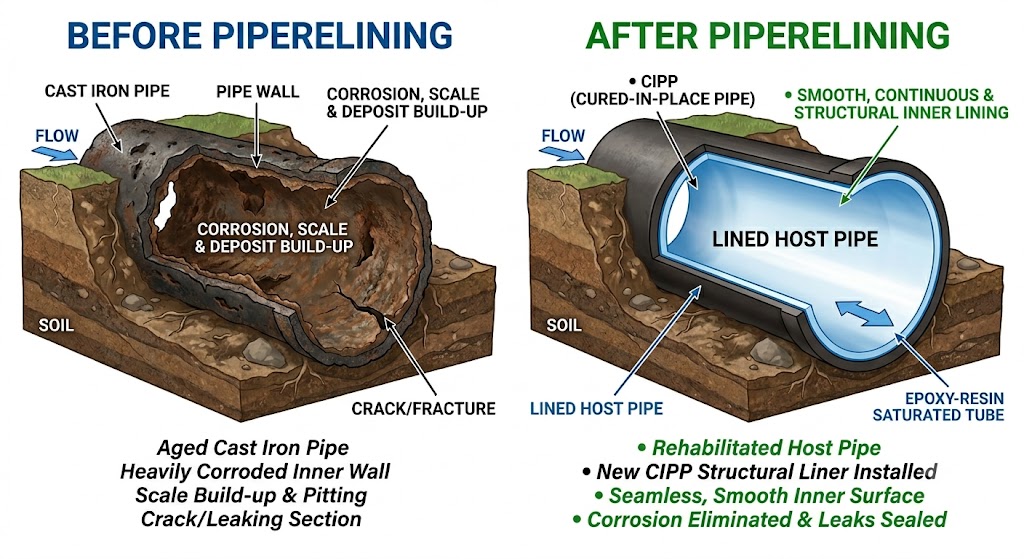
It addresses a wide range of failure modes. Cracked or broken pipes, tree root intrusion, corrosion, leaks, collapsed or misaligned sections, and pipes approaching end of service life are all problems relining is specifically designed to resolve. Yes, pipe relining can fix tree root damage. Robotic cutting tools remove the root intrusion during preparation, and the cured liner creates a sealed, joint-free surface that roots cannot re-enter.
Pipes under concrete slabs, driveways, and basement floors are also well within scope. One of the most common applications Hydro Logic handles is sub-surface infrastructure beneath active construction sites, where breaking up concrete is simply not an option.
What causes sewer pipes to fail, and how do I know if mine needs relining?
Most pipe failures are not sudden. They develop gradually, driven by age, environment, and the conditions the pipe operates in. Understanding the causes helps asset owners and facility managers catch problems before they escalate.
The most common causes of sewer pipe failure include:
| Corrosion | Hydrogen sulphide gas produced in sewer systems reacts with moisture to form sulphuric acid, which progressively eats through concrete and steel pipes. |
| Tree root intrusion | Roots seek out moisture and nutrients inside pipes, entering through joints and cracks and expanding until they cause blockages or structural damage. |
| Ground movement | Settlement, subsidence, and soil shifting over time cause pipes to crack, misalign, or separate at joints, allowing infiltration and structural weakening. |
| Age and material fatigue | Clay, concrete, and early PVC pipes often exceed their design life, becoming brittle and prone to cracking under normal operating loads. |
| Chemical attack | Industrial and process waste, petroleum products, and cleaning agents can degrade pipe materials over time if the lining is not chemically resistant. |
| Poor original installation | Improperly graded pipes, weak joint seals, or inadequate bedding can accelerate deterioration long before the pipe reaches end of its design life. |
The signs that a pipe may need relining include recurring blockages that cannot be resolved by jetting alone, slow drainage across multiple fixtures, foul odours from drains, unexplained wet patches or sinkholes in landscaping, and a noticeable drop in performance. In a commercial or industrial context, persistent drainage issues that keep recurring despite maintenance are a strong indicator that the underlying asset needs structural attention, not just a clearance.
The definitive way to know is a CCTV inspection. There is no substitute for putting a camera in the pipe and seeing the actual condition of the asset. At Hydro Logic, every project starts here, because assumptions are expensive and an inspection is not.
How much does pipe relining cost, and how long does it take?
Pipe relining is priced and scheduled on a job-by-job basis. There is no standard figure or fixed timeline that applies across all projects, because no two assets are the same. The cost and duration of any relining project are shaped by the specific conditions of the asset, its location, and what is required to restore it to performance.
The factors that most directly influence cost include:
| Pipe diameter | Small bore and large bore pipes require different liner systems, equipment configurations, and installation time. |
| Length of repair | A patch repair over a localised defect differs significantly from a full mainline reline covering many metres. |
| Asset condition | Heavily deteriorated pipes require more intensive preparation before lining can take place, adding time and resource. |
| Access and site constraints | Confined spaces, height restrictions, live operations, or remote locations all affect mobilisation and methodology. |
| Liner specification | System selection is based on the operating environment: chemical exposure, pressure, flow conditions, and required service life. |
| Site-specific requirements | Permit-to-work processes, confined space entry, traffic management, or client safety systems each add coordination requirements. |
On timing: straightforward relining works on a single run of pipe can often be completed within a day. More complex projects involving multiple access points, significant preparation works, large diameter assets, or UV-cured systems may take several days. Because the process is trenchless, there is no excavation, no reinstatement, and no extended site establishment, meaning the overall disruption period is significantly shorter than traditional replacement in almost every scenario.
What you should expect from any credible relining contractor is a scoped proposal based on the actual condition and configuration of your asset, not a ballpark figure offered without inspection. At Hydro Logic, every project begins with a CCTV assessment so the solution and the price are based on evidence, not assumptions.
Is pipe relining cheaper than pipe replacement?
In most commercial, industrial, and civil contexts, yes. Not just in direct project cost, but across the full picture when you account for disruption, downtime, reinstatement, and lifecycle risk.
Traditional excavation and pipe replacement carries a range of costs that rarely appear in a like-for-like comparison. The quote might cover the pipe itself, but it rarely accounts for everything surrounding it:
| Traditional excavation | Pipe relining | |
|---|---|---|
| Excavation | Excavation, shoring, and spoil removal required | No excavation or surface reinstatement |
| Reinstatement | Concrete, asphalt, tiling, and landscaping must be reinstated | Minimal disruption to surrounding surfaces |
| Downtime | Operational downtime and production interruption | Faster delivery, often without shutdowns |
| Site logistics | Traffic management and heavy machinery required | Reduced machinery, transport, and site footprint |
| Timeline | Extended project timelines and site establishment | Significantly shorter overall disruption period |
| Design life | New pipe only, no additional protection | 50-year design life with 10-year warranty |
| Adjacent services | Risk of damage to adjacent underground services | No risk to adjacent underground services |
The real cost of excavation is rarely the excavation itself. It is the downtime, the reinstatement, the disruption to operations, and everything around it. Relining removes most of that from the equation entirely.
There are situations where excavation remains the right answer: where structural damage is severe enough that a liner cannot be introduced, where access points are insufficient, or where ground conditions require direct intervention. A qualified contractor will tell you this upfront. Where relining is viable, it consistently delivers better value over the life of the asset.
Relined pipelines are engineered for long-term structural performance.
Relining systems selected by Hydro Logic are backed by installation warranties.
Trenchless methodology. No slab breaking, no road opening, no reinstatement costs.
Straightforward relining works on a single run of pipe can often be completed within a day.
On longevity: pipe relining is a permanent structural repair, not a temporary fix. Relining systems installed by Hydro Logic are designed for a 50-year service life and backed by a 10-year installation warranty. The cured liner does not corrode, does not crack at joints, and provides a continuous sealed surface. For assets in corrosive or chemically aggressive environments, relining with the correct liner specification will often outlast a replacement pipe installed without the same level of protection.
What is included in a pipe relining quote?
A detailed pipe relining quote from a reputable contractor should give you enough information to understand exactly what work is being proposed, what system is being used, and what performance you can expect. Vague quotes without supporting data are a warning sign. Before accepting any proposal, make sure it clearly addresses the following:
- A summary of the CCTV inspection findings, including identified defects and their locations
- The scope of cleaning and preparation works required prior to lining
- The specified liner system, including manufacturer, product type, and thickness
- Confirmation that the liner is appropriate for the chemical and operating environment of the asset
- The method of installation: inversion, pull-in-place, UV-cured, patch repair, or full mainline
- Whether the works can be completed without service interruption, or what bypass provisions are included
- Post-installation CCTV inspection to verify the quality of the completed work
- Warranty terms: duration, what is covered, and who is backing it
- Site-specific requirements such as confined space entry, traffic management, or permit-to-work provisions
- Compliance with relevant Australian and international standards
Pay particular attention to the warranty. An applicator-issued warranty and a manufacturer-backed warranty are very different things. Manufacturer warranties, where the product manufacturer stands behind both the materials and the installation, provide a substantially higher level of assurance for asset owners and their stakeholders. At Hydro Logic, our relining systems are selected specifically to deliver this standard of performance assurance.
If a quote does not include post-installation CCTV and documented warranty terms, ask for both before proceeding. These are not optional extras. They are evidence that the work has been completed to standard and that the contractor stands behind the outcome.
Hydro Logic works with engineers, asset owners, councils, and Tier-1 contractors across Australia to deliver trenchless pipe relining where conditions are complex, environments are live or hazardous, and conventional repair is not an option. Every project begins with a proper inspection, and every proposal is scoped to the specific asset.